
Patcell · Game development at Patcell
Looking for a game development partner? Explore what Patcell builds
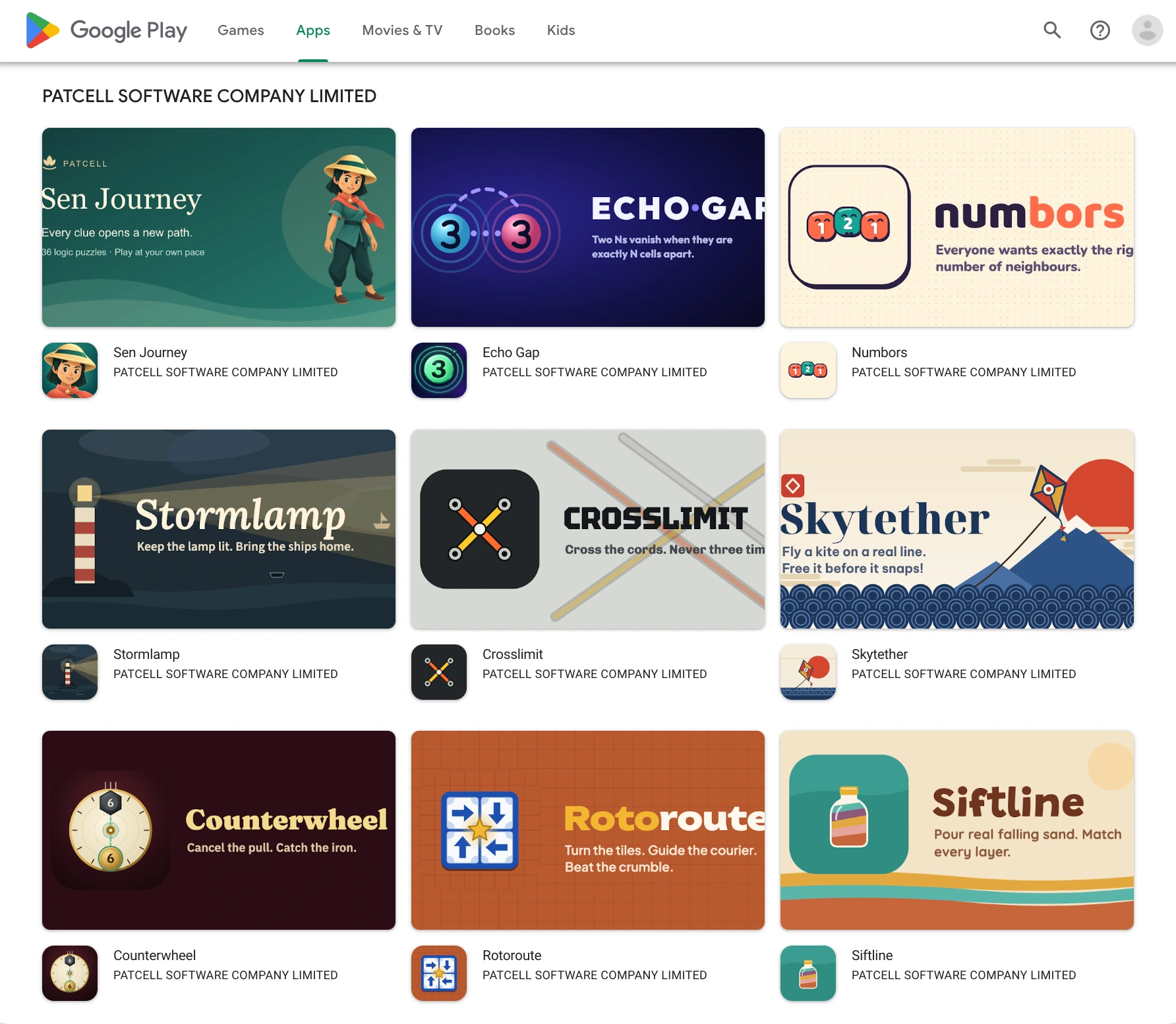
Get to know Patcell through six published Android games. Official Google Play screenshots reveal distinct mechanics, visual identities and thoughtful decisions for small screens.
Before you choose a studio for your next game, there is a useful place to begin: look at the games it has already made.
How quickly can you understand the screen? Does a simple action lead to an interesting decision? Do the mechanics, controls and artwork feel like parts of the same idea?
At Patcell, our published game collection gives you something concrete to explore. A balance wheel becomes a puzzle about opposing forces. A flower market becomes a problem of timing and priorities. A tiled plaza becomes a route you have to rebuild while a courier crosses it.
This feature takes a closer look at six of our Android games, using screenshots from their official Google Play listings. Together, they show several sides of our work in game design, touch interaction and visual presentation. You can follow every example to the store and judge the experience for yourself.
Patcell’s public US Google Play collection lists 14 Android games as of October 18, 2026. The games featured here are published under PATCELL SOFTWARE COMPANY LIMITED.
Visit Patcell’s official Google Play collection →Give a simple idea room to grow
A strong starting point can be explained in a sentence. The interest comes from what the player can do with it.
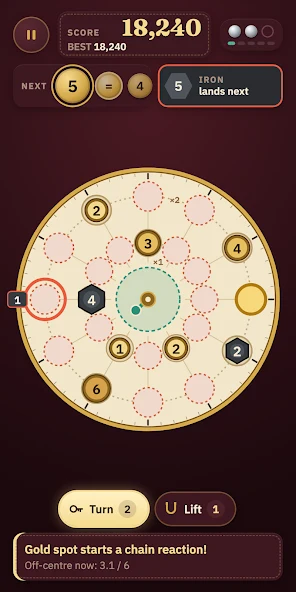
In Counterwheel, you place numbered weights on a wheel and try to keep it balanced. Matching weights on opposite spokes cancel, while the outer ring doubles a weight’s pull. A cancellation also rotates the outer ring, potentially aligning another pair. That makes each placement a question about both balance now and possibilities next.
The screen supports that idea with a circular board, brass weights, marked positions and a balance indicator. Its store description explains how green positions signal cancellations, gold positions signal chains and red positions warn of a tip. You can consider a move without racing a timer.
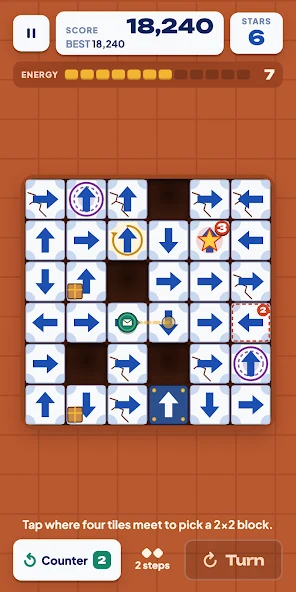
Rotoroute begins with a different rule: rotate a two-by-two block of arrow tiles, then let the courier follow the arrows. A rotation changes four tiles together. Fixing the route ahead can also change a route you hoped to use later, and tiles wear away as the courier leaves them.
These are two different ways to turn a compact action into a sequence of decisions. For someone planning a new game, that is an important part of the brief: define an action that feels clear, then give its consequences enough depth to explore.
Make the next decision readable
Challenge is more satisfying when the player can understand the information in front of them.
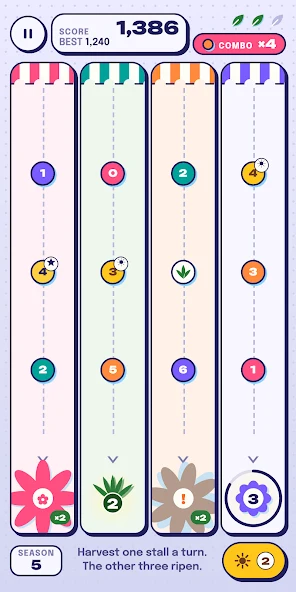
Bloom Queue presents four flower stalls. Each turn, you harvest one stall while the others continue ripening. Harvest at the right moment and your combo grows; leave a flower too long and it wilts. The visible waiting lines let you consider what is coming several turns ahead.
The screenshot makes the scheduling problem tangible. Four vertical queues, flower states and numbered countdowns put the relevant information in the player’s path. The game has no real-time timer: the pressure comes from choosing which queue to serve, rather than from making the choice quickly.
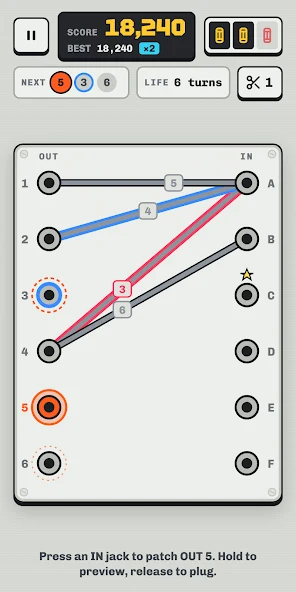
In Crosslimit, the information takes the form of a patch panel. You connect an OUT jack to an IN jack. Crossings earn points, but they also load the cords: a third crossing burns a cord. The next jacks, cord lifetimes and remaining fuses shape the decision.
Previewing a connection is part of the interaction described on its store page. That allows the player to examine a route before committing. Bloom Queue’s waiting lines and Crosslimit’s connection previews illustrate the same design priority in different forms: let people see enough to make a deliberate choice.
Build a visual identity around the rules
A visual theme can help explain what is happening, as well as give a game its character.
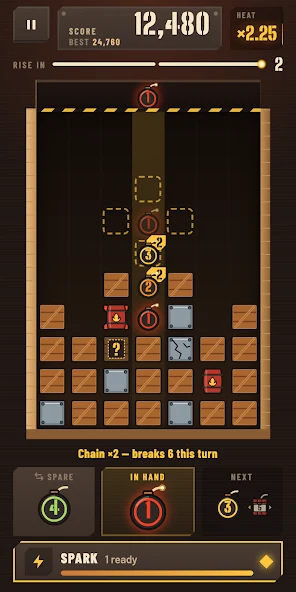
Fusewell puts its puzzle inside a demolition shaft. Bombs carry countdowns; each drop advances the fuses. Blasts clear debris and can accelerate other bombs, setting up successive waves. The board rises from below, so keeping space open matters as much as building a satisfying chain.
Its dark shaft, crates, warning stripes and numbered bombs make that situation legible. The screenshot’s landing preview shows where a bomb will go, while the spare slot and next bomb help frame the following decision.
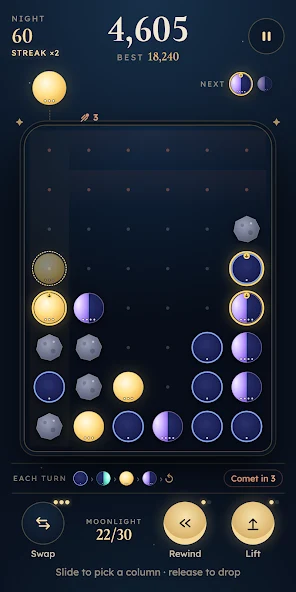
Lunar Cascade takes a different direction. A square clears when it contains all four moon phases. After a drop, the night advances: existing unanchored moons change phase, while the newly dropped moon stays as it is. A useful arrangement may therefore be one that becomes complete on the next turn.
The moon shapes carry the rule directly into the artwork. The store listing describes additional colour and dot cues, alongside a reduce-motion option. That is a specific example of presenting information in more than one way.
Seen together, these games show how varied a mobile puzzle can look without losing focus on its central action. The theme, board and feedback all have a job to do.
Explore the wider Patcell collection
These six games are one view of our portfolio. There are other directions to discover:
- Sen Journey brings 36 illustrated logic puzzles into a countryside adventure.
- Stormlamp makes a lighthouse beam the centre of a game about attention, navigation and heat.
- Skytether builds a kite-flying challenge around the tension and obstacles affecting its line.
- Siftline turns pouring coloured sand into a task of timing and precision.
- Picadeck fits a card-based dungeon adventure into a three-by-three grid.
- Echo Gap, Numbors and Inkslice explore distance, neighbours and the consequences of a straight cut.
For more screenshots and introductions, visit our tour of all 14 games or browse the Patcell showcase.
What to look for in a development partner
The portfolio offers a practical way to start evaluating Patcell. Choose a few games and look at four things:
- The central idea. Can you explain what the player does and why the next move is interesting?
- The interaction. Do the controls and previews communicate the choice the player is making?
- The visual identity. Do the artwork and interface support the subject of the game?
- The published product. Can you inspect a real listing, see the screenshots and try the experience on a supported device?
Our collection gives you concrete examples to discuss across all four. It also gives a conversation about a future project a useful vocabulary: the patient planning of Counterwheel, the changing routes of Rotoroute, the queue decisions of Bloom Queue or the cascading effects of Fusewell.
Your product will have its own audience and goals. The right conversation starts there, then works towards a clear playable idea and an appropriate scope.
Bring your next idea to Patcell
Perhaps you are planning a mobile game, exploring an interactive experience for your brand, or looking for a team to discuss a new digital product. Tell us who it is for, what you want people to experience and where you want to take it.
Explore our games first. Find the ideas that interest you. Then let’s talk about yours.
Start a conversation with Patcell →
Explore our apps and games services →
The cover is a direct browser capture of Patcell’s Google Play collection showing all 14 games together. All six gameplay screenshots in this feature come from the official Google Play listings linked in their captions. Images are compressed for the website without altering the game content. The collection was checked on October 18, 2026. Links select the US storefront for browsing; availability depends on your Play country and device. See each listing for current features, ads and in-app purchases. Written and published by Patcell.