
Patcell · Inside our game collection
Small screens, big ideas: explore 14 games made by Patcell
A lighthouse in a storm. A kite on a tightening line. A puzzle hidden in a neighbourhood. Discover the range of Patcell’s game development through real games, official screenshots and Google Play links.
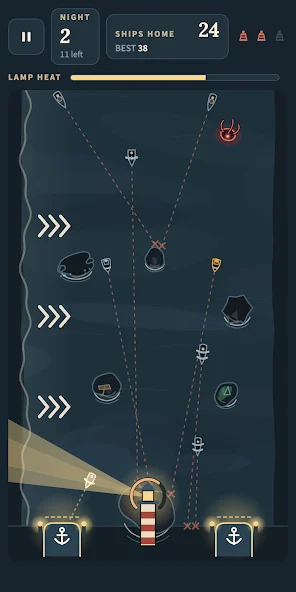
A ship is heading towards the rocks. Your lighthouse can guide it home—but another ship needs help on the opposite side, and the lamp is getting hot.
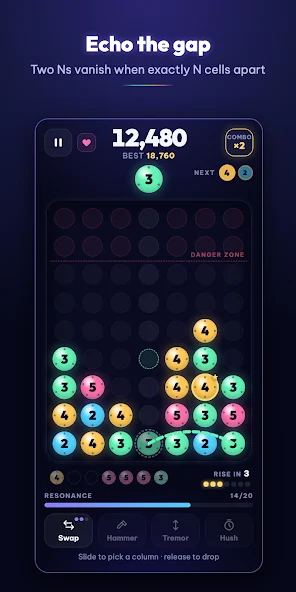
In another game, the challenge is quieter. A numbered neighbour wants just the right amount of company. Place the next newcomer carefully and a whole chain of happy departures could follow.
Both experiences come from Patcell. So do a kite flight across an Edo-inspired sky, a journey through illustrated logic puzzles, and a conveyor belt waiting for precisely layered sand.
Our game collection is a practical introduction to what we make: small, playable systems with distinct rules, visual identities and reasons to try one more move. As of October 18, 2026, Patcell’s public US Google Play collection contains 14 Android games. This tour brings them together, with screenshots taken from their official store listings and direct links so you can explore the products yourself.
Start with a game that catches your curiosity, or browse the whole collection. Every store link below leads to a listing under PATCELL SOFTWARE COMPANY LIMITED.
Explore Patcell on Google Play →Sen Journey: giving logic a world to live in
A good puzzle gives you a question. A memorable setting gives you a reason to stay with it.
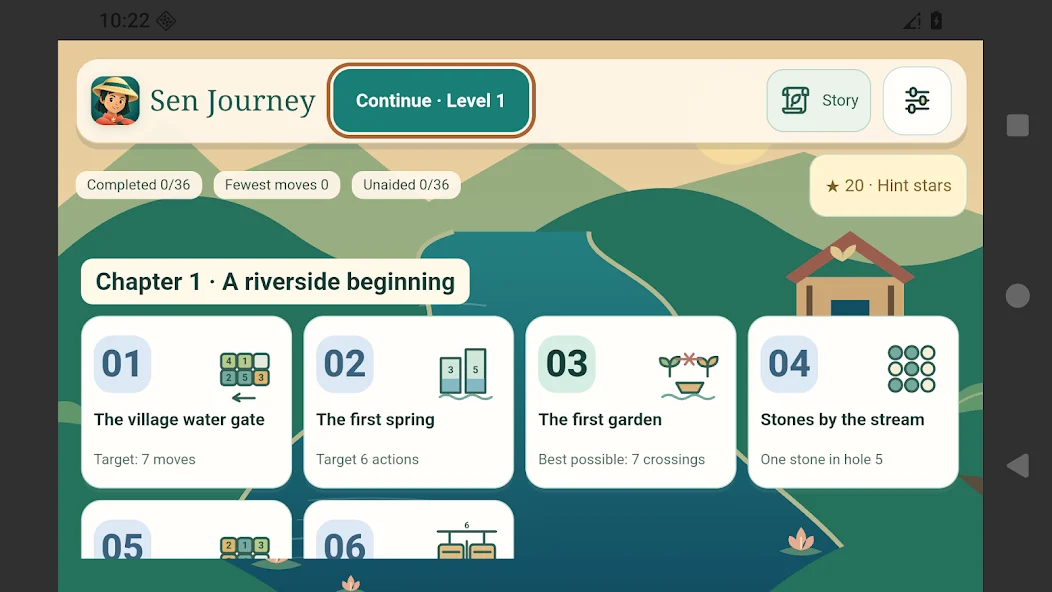
Sen Journey combines the two. Follow Sen through villages and gardens, with 36 puzzles across six chapters. Arrange numbers, plan river crossings, connect routes and look for patterns. Illustrated rules introduce each challenge, while the free Solve with Sen guidance offers a way forward when an idea has not quite clicked.
There is a particular pleasure in realising that the boat’s return trip matters just as much as its first crossing. Sen Journey makes room for that discovery: try a plan, undo a move and think again. All levels and the guidance can be completed free, including offline, with ads and optional purchases described on the store page.
For our portfolio, Sen Journey shows how several puzzle families can share a coherent character, setting and progression. The chapter screen makes that structure visible before the first move.
Explore Sen Journey on Google Play → · Read our full introduction
Echo Gap and Numbors: a simple rule can open a deep puzzle
How much can you build around a single relationship?
In Echo Gap, the relationship is distance. Matching numbered tiles disappear when they sit exactly that number of cells apart in a row or column. The falling tiles change the gaps, and a careful placement can start a chain. Meanwhile, pressure rows gradually push the board upwards.
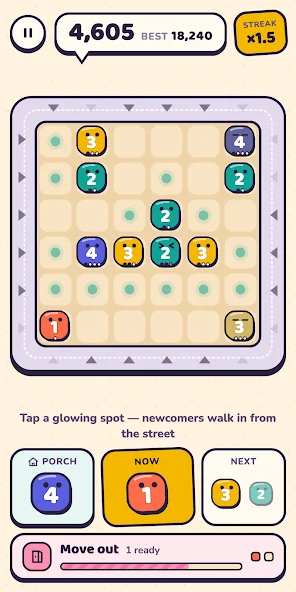
In Numbors, the relationship is company. Each numbered character wants a particular number of neighbours. Satisfy that request and the character leaves; the departure changes the neighbourhood around it. You are managing both the next placement and the space it will create.
The appeal comes from seeing consequences. Both games put a readable board at the centre of the experience, then let a small decision ripple outwards. Their store listings also describe daily challenges, giving players a shared starting point for finding their own solutions.
Stormlamp and Skytether: make one touch matter
A simple control can carry a difficult decision.
In Stormlamp, you hold to shine a lighthouse lamp, drag to aim and release to let it cool. Ships need the beam to navigate safely; rocks, monsters and worsening conditions compete for your attention. The question is immediate: which ship needs the light now, and how long can you afford to keep it on?
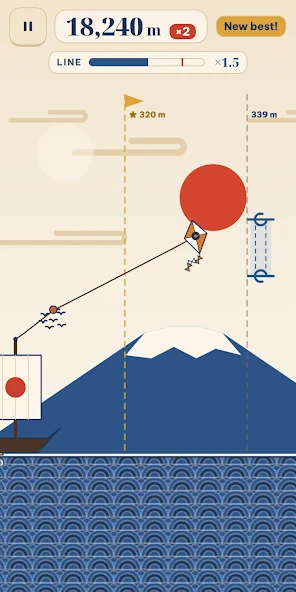
Skytether turns holding and releasing into a different kind of tension. Tighten the line to climb; let go to dive. The kite is tethered to a ship, and its line can catch on obstacles. Flying near the limit offers more scoring potential, but you still need to free the line before it snaps.
Look at the screenshots together: a dark sea crossed by warning lines, then a spare sky framed by graphic waves and a red sun. The visual language supports the subject of each game. The controls are compact, while the choices remain specific to the world you are playing in.
Siftline and Inkslice: turn familiar materials into play
Sand and paper suggest different gestures. Pour one. Cut the other.
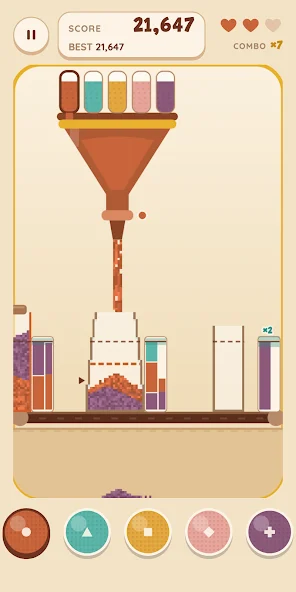
Siftline asks you to fill moving cups with layers of coloured sand. Hold to pour, release to stop, and judge the level before the glass passes the funnel. Its listing describes individually simulated grains that stream, pile and spill, making the material itself part of the challenge. Matching a recipe depends on both timing and restraint.
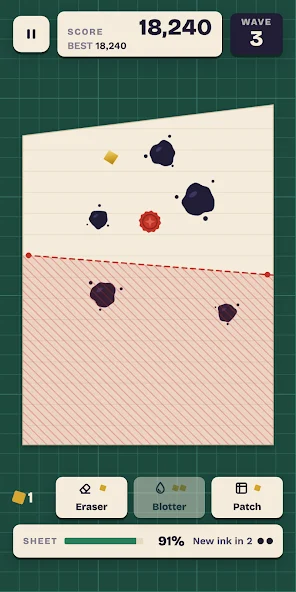
In Inkslice, every straight cut is a commitment. The side carrying the wax seal stays; the other side falls away. You want to remove spreading ink without losing too much paper or exposing the seal. A live preview lets you consider the result before making the cut.
These games show another side of Patcell’s work: building an interaction around something people already understand, then giving it rules that reward practice. A funnel, a dashed fill line, a sheet and a seal explain a great deal before a player reads a paragraph of instructions.
Picadeck: an adventure in nine cards
A dungeon does not need a sprawling map to make you think ahead.
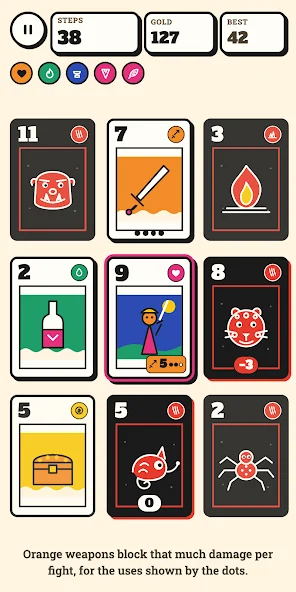
Picadeck places your hero in a three-by-three grid of face-up cards. Each move can bring a monster, weapon, potion, trap or gold. The cards slide behind you and a new card appears, changing the route for the next decision. Charms alter a run, while bosses punctuate the journey.
Its bold card illustrations give different objects a distinct presence in a small space. The design challenge is to fit movement, danger, resources and progression onto one readable screen—and still leave the player with an interesting choice.
Six more directions to explore
The collection continues beyond the games pictured above. Each of these has its own official Google Play page:
- Bloom Queue: choose which flower stall to harvest while the other queues continue ripening. A scheduling puzzle where acting on one queue changes the urgency of the others.
- Counterwheel: balance weights on two rings, cancel matching opposites and plan for the rotation that follows.
- Crosslimit: route cords across a patch panel. Crossings score, but a third crossing burns a cord.
- Rotoroute: rotate blocks of arrow tiles to guide a courier across a surface that wears away. Improving one route changes three other tiles with it.
- Fusewell: place bombs, align their countdowns and build chains of blasts to clear rising debris.
- Lunar Cascade: complete squares containing four moon phases while the phases themselves advance after each drop.
What these games say about Patcell
Taken together, the collection makes our game development capability tangible. You can see how we approach rules, touch interaction, visual communication and product delivery across different kinds of play.
A preview in Inkslice, a course line in Stormlamp and an illustrated rule in Sen Journey all serve a related purpose: help the player understand a decision. The forms differ because the games ask different things of the player.
The range of presentation matters too. Sen Journey’s illustrated countryside, Picadeck’s graphic cards and Skytether’s stylised skyline give each product its own identity. Game development brings those visual choices together with mechanics and interface design into something people can actually use.
The strongest introduction to that work is the work itself. Open a listing, examine the screenshots, read the features and try a game. These are published products you can inspect, and this collection offers a starting point for discussing what Patcell could build with you.
Find your next game—or start a conversation
If you are here to play, follow the idea that caught your attention. Would you rather save a ship, clear a neighbourhood, protect a paper seal or solve a crossing?
Browse all 14 games in the Patcell showcase →
If you are exploring a game, app or interactive product for your own business, we would be glad to hear what you have in mind. Share the audience, the experience you want to create and the problem you want to solve.
Talk to Patcell about your product →
Screenshots and icons in this feature and the linked catalogue come from Patcell’s official Google Play listings, checked on October 18, 2026. Images are resized and compressed for the website; gameplay content is unchanged. Store links use the US storefront for browsing. Installation availability depends on your Google Play country and device; check each listing for current features, advertising and purchase details. This is a publisher introduction by Patcell.